Manchester

Map of the Manchester Area
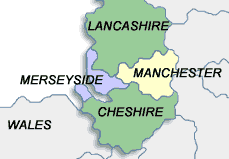
Map of Manchester

County Council

Greater Manchester is located in the North West of the UK and is a metropolitan county with a population of around 2.55 million (source: "T 09: Quinary age groups and sex for local authorities in the UK; estimated resident population Mid-2006 Population Estimates". National Statistics (30 May 2008). Retrieved on 8 July 2008.). It is one of the largest metropolitan areas in England and was created as a result of the Local Government Act 1972 on April the 1st of that year (source: Office of the Deputy Prime Minister. "Local Government Finance Statistics England No.16". local.odpm.gov.uk. Retrieved on 21 February 2008.). The county is bordered by Derbyshire to the south east, Cheshire to the south west and West Yorkshire to the north east. It is also land locked by Lancashire and Merseyside. It (the Greater Manchester Urban Area) is the third most populous conurbation in England (source: link). The county spans an area of 493 square miles and has a population density of 5172 people per square mile.

Even though the modern county was not formed until the 1974 there has been a history for settlements in the area that goes back centuries. All over the county there is evident of Iron Age inhabitation especially at the area of Mellor. The county is completely landlocked and the eastern side is dominated by the Pennines. The Mersey and the Tame rise in the Pennines and run through the county; other rivers include the Douglas, the Irk and the Beal. The highest point in Greater Manchester is Black Chew Head, in the Parish of Saddleworth, and it is at 542 metres above sea level.

The county is primarily urban although there are some low densely populated areas. The largest area of prime farmland in the county is at Chat moss and is 10.6 square miles. The Industrial Revolution had a large impact Greater Manchester and much of its wealth was generated during that time. The first cotton mill in the world was built in the town of Royton (source: "Oldham's Economic Profile - Innovation and Technology". Oldham MBC web pages. Oldham Council. Retrieved on 27 October 2006.) and several of the settlements in the county are former mill towns. However, events such as the Lancashire Cotton Famine and post war economic depression caused a rapid decline in these traditional industries. Modern Greater Manchester is an economic centre for the North West of the UK and represents over £42 billion of the UK regional GVA (source: Greater Manchester Economic Data". Midas Manchester (2003). Archived from the original on 13 August 2007. Retrieved on 10 July 2008.). The county is famous for its football team Manchester United which was voted in 2008 by Forbes to be the world's richest club (source: Soccer Team Valuations #1 Manchester United", forbes.com, Forbes.com LLC (30 April 2008). Retrieved on 2 May 2008.).

Museum

Transport

Banks and Building Societies

Tourism - Official Site

News and Media

University

Library


Find: Near: